When your air conditioner is running but your home still feels warm, it can be difficult to know whether you’re dealing with a minor issue or a serious HVAC problem.
This is also one of the most common reasons homeowners contact Cooling & Heating Repair during hot weather.
Our HVAC technicians regularly diagnose air conditioning systems that appear to be working normally—the thermostat is set to cool, the indoor fan is running, and the outdoor unit may even be operating—but the temperature inside the home continues to rise.
The good news is that an AC system that isn’t cooling doesn’t automatically mean you need a new air conditioner.
Sometimes the problem is relatively simple. Other times, the symptoms can indicate a refrigerant leak, failing electrical component, airflow restriction, or compressor problem.
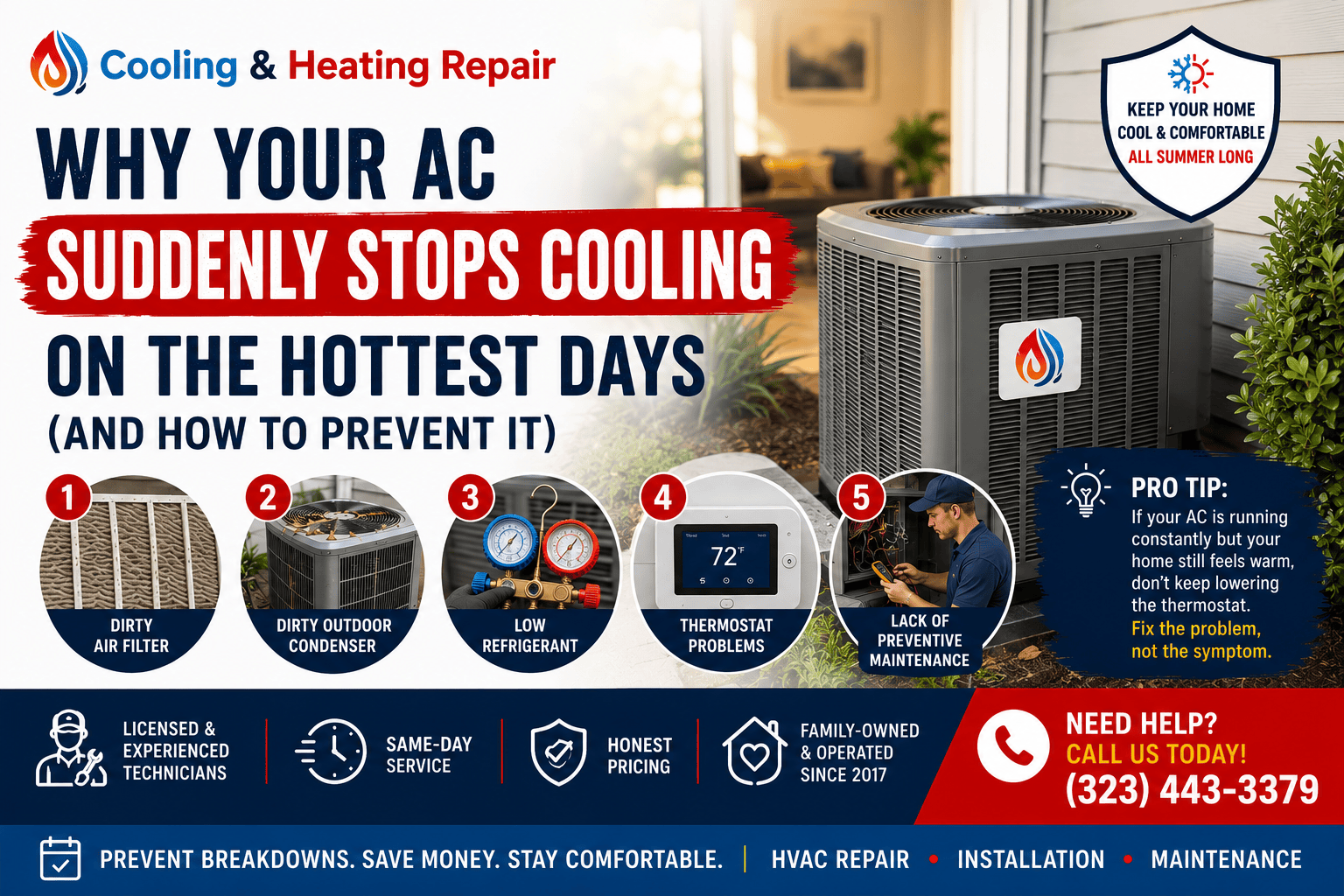
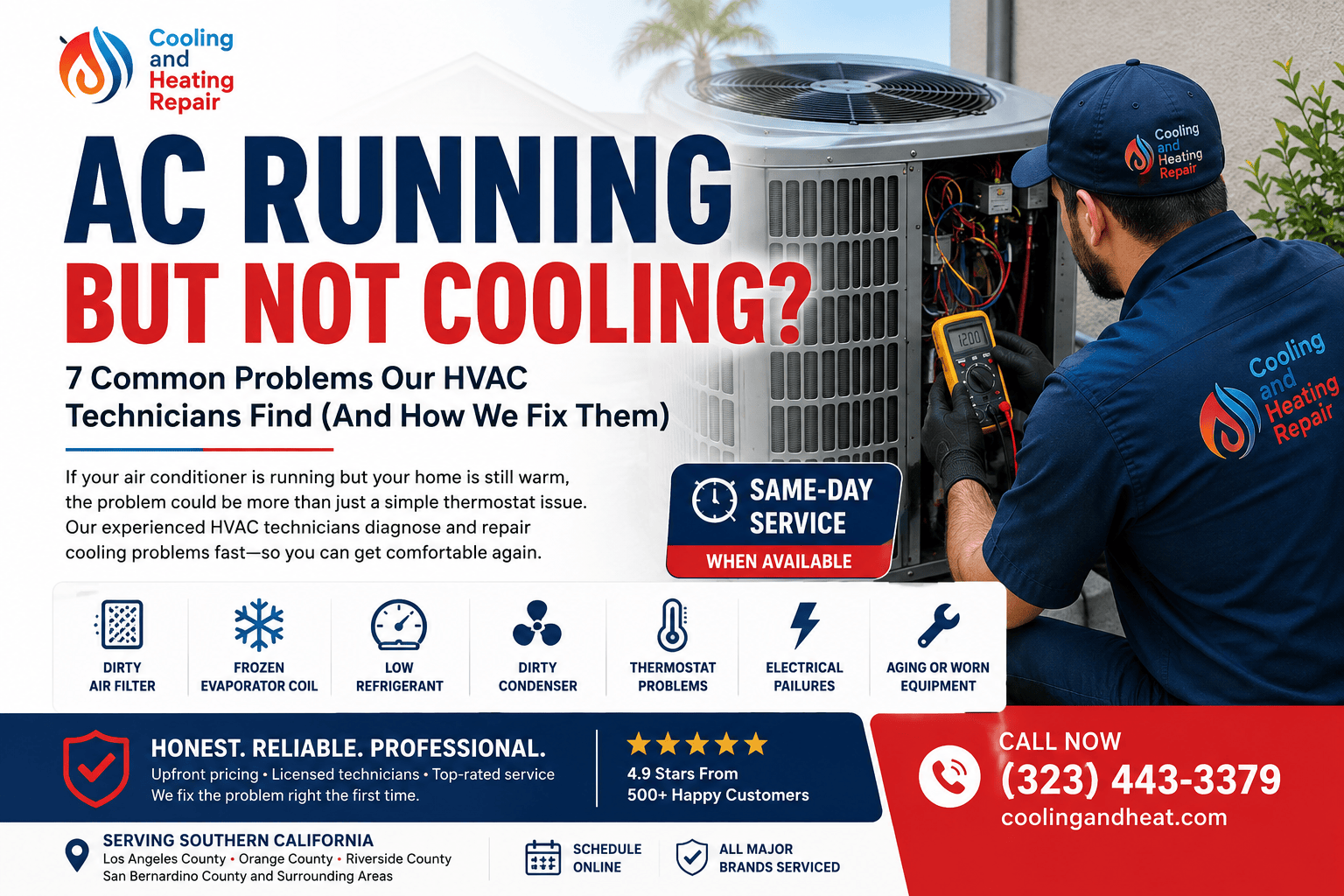
Below are seven of the most common issues our technicians look for when diagnosing an air conditioner that runs but doesn’t cool properly.
1. A Dirty Air Filter Is Restricting Airflow
The first thing homeowners should check is also one of the easiest: the air filter.
Your HVAC system needs a steady flow of air across the evaporator coil to remove heat from your home. As the filter collects dust, pet hair, and other debris, airflow can gradually become restricted.
A severely clogged filter may cause:
- Weak airflow from the vents
- Longer cooling cycles
- Higher electricity bills
- Uneven temperatures throughout the home
- Ice forming on the evaporator coil
- Reduced cooling capacity
In Southern California, an air conditioner may operate for many hours every day during warmer periods. That makes filter maintenance especially important.
At Cooling & Heating Repair, checking the filter and measuring airflow are basic parts of diagnosing cooling problems. A dirty filter alone may not always be the entire problem, but it can contribute to several other HVAC issues.
For most homes, filters should generally be inspected every one to three months. Homes with pets, construction dust, or heavy HVAC usage may require more frequent replacement.
2. The Evaporator Coil Has Frozen
Finding ice on an air conditioner during a hot day sounds strange, but frozen evaporator coils are a surprisingly common AC problem.
The evaporator coil is located inside the indoor portion of your HVAC system. Refrigerant flowing through the coil absorbs heat from the air moving across it.
If something interferes with this process, the temperature of the coil can drop too far and moisture can freeze around it.
Common causes include:
- Restricted airflow
- Dirty air filters
- Blocked return vents
- Blower motor problems
- Dirty evaporator coils
- Low refrigerant levels
Once a layer of ice develops, airflow and heat transfer become even worse.
Eventually, you may notice that your air conditioner continues running while very little cool air comes from the vents.
If you can see ice on refrigerant lines or around the indoor HVAC equipment, continuing to run the system usually isn’t a good idea.
Turning the cooling system off allows the ice to thaw, but it doesn’t solve the underlying problem.
A technician still needs to determine why the coil froze in the first place.
3. Your Air Conditioner May Be Low on Refrigerant
Refrigerant is one of the most important parts of the cooling process.
Contrary to a common misconception, an air conditioning system does not normally “use up” refrigerant like a car uses gasoline.
If the refrigerant charge becomes significantly low, there may be a leak somewhere in the system.
Possible signs include:
- AC running continuously
- Warm or slightly cool air from the vents
- Ice on refrigerant lines
- Poor cooling during the hottest part of the day
- Unusually high electricity bills
- Hissing or bubbling noises near HVAC equipment
Simply adding refrigerant without determining why it became low may only provide a temporary solution.
During a service visit, a Cooling & Heating Repair technician can evaluate system pressures, temperatures, and other operating conditions to determine whether a refrigerant-related problem is likely.
Depending on what we find, additional leak detection may be recommended.
The correct solution depends on the location of the leak, age of the equipment, refrigerant type, condition of the system, and cost of the repair.
4. The Outdoor Condenser Cannot Release Heat Properly
Your air conditioner doesn’t actually “create cold air.”
Instead, it removes heat from inside your home and transfers that heat outside.
The outdoor condenser plays a critical role in this process.
When condenser coils become covered with dirt or airflow around the outdoor unit is restricted, the AC system has a harder time releasing heat.
Common problems around outdoor units include:
- Leaves and landscaping debris
- Dirt buildup
- Grass clippings
- Objects stored too close to the unit
- Damaged condenser fins
- Condenser fan problems
During periods of high outdoor temperatures, condenser problems become particularly noticeable because the system is already operating under demanding conditions.
A struggling condenser may still run, but cooling performance and efficiency can decline significantly.
Professional HVAC maintenance typically includes inspecting the outdoor equipment and making sure the system has adequate airflow.
5. A Capacitor, Contactor, or Other Electrical Component Is Failing
Air conditioners rely on several electrical components to start and operate properly.
One of the most common components HVAC technicians encounter is the capacitor.
Capacitors help certain motors start and run efficiently. As capacitors weaken, the system may behave unpredictably.
For example, you may hear the outdoor unit trying to start, notice intermittent cooling, or discover that the indoor fan works while the outdoor equipment doesn’t operate correctly.
Other potential electrical problems include:
- Failed contactors
- Loose electrical connections
- Damaged wiring
- Blower motor problems
- Condenser fan motor problems
- Control board failures
- Tripped breakers
Electrical HVAC problems should generally be handled by a qualified technician.
Replacing a part without properly testing the system can result in an incorrect diagnosis because multiple problems can produce very similar symptoms.
At Cooling & Heating Repair, our technicians test electrical components as part of the diagnostic process instead of simply replacing parts based on symptoms.
6. Your Thermostat May Be Causing the Problem
Sometimes the HVAC equipment itself isn’t the source of the problem.
The thermostat is essentially the control center that tells your heating and cooling equipment when to operate.
Before scheduling service, homeowners can perform a few simple checks.
Make sure:
- The thermostat is set to Cool
- The temperature is set lower than the current room temperature
- The fan isn’t accidentally set to an inappropriate setting
- The thermostat has power
- Batteries are fresh if the thermostat uses replaceable batteries
Smart thermostats introduce additional possibilities, including configuration problems, communication issues, software settings, or incorrectly connected wiring.
Thermostat problems aren’t always obvious.
A display may appear normal even though the thermostat isn’t properly communicating with the HVAC system.
That’s why technicians often verify thermostat operation during an AC diagnostic.
7. The AC System Is Aging or Has a More Serious Mechanical Problem
Unfortunately, not every air conditioning problem is caused by an inexpensive component.
As HVAC equipment gets older, mechanical wear becomes increasingly important.
An older system may have issues involving:
- Compressor performance
- Refrigerant leaks
- Blower motors
- Fan motors
- Electrical components
- Dirty or deteriorated coils
- Airflow problems
- Ductwork
The compressor is one of the most important—and expensive—components of an air conditioning system.
If a major repair is required on an older AC system, homeowners often have to decide whether repairing or replacing the equipment makes more financial sense.
At Cooling & Heating Repair, we believe this decision should be based on the actual condition of the system rather than automatically recommending replacement.
Factors we consider include:
- Age of the equipment
- Overall HVAC condition
- Cost of the required repair
- Previous repair history
- Energy efficiency
- Refrigerant type
- Comfort problems
- Expected remaining equipment life
Sometimes repairing the system is clearly the better choice.
In other situations, putting significant money into aging equipment may not make financial sense.
A proper diagnostic allows the homeowner to make that decision with much better information.
Why Does My AC Cool at Night but Struggle During the Day?
This is another problem our technicians frequently encounter.
An air conditioner may seem perfectly adequate in the morning or evening but struggle when outdoor temperatures rise.
Several conditions can cause this.
The HVAC system may be slightly undersized, refrigerant levels may be incorrect, airflow may be restricted, condenser performance may be reduced, or the home itself may be gaining heat faster than the AC can remove it.
Insulation, windows, duct leakage, attic temperature, and direct sunlight can also affect indoor temperatures.
If the system previously cooled the home normally and has suddenly started struggling, however, that change deserves investigation.
HVAC systems don’t usually lose a significant amount of cooling capacity for no reason.
What Our Technicians Check During an AC Diagnostic
Good HVAC diagnostics involve much more than looking at the thermostat and guessing which component failed.
When Cooling & Heating Repair receives a call about an air conditioner that isn’t cooling, our technician evaluates the system to determine what is actually happening.
Depending on the equipment and symptoms, the diagnostic process may include:
- Inspecting the thermostat
- Checking the air filter
- Inspecting indoor and outdoor HVAC equipment
- Measuring supply and return air temperatures
- Checking airflow
- Testing electrical components
- Inspecting the evaporator and condenser
- Evaluating blower operation
- Checking refrigerant operating conditions
- Inspecting the condensate system
- Listening for unusual compressor or motor noises
- Looking for signs of overheating or electrical damage
Only after identifying the problem should repair options be discussed.
This is important because HVAC symptoms can be misleading.
For example, “warm air from the vents” could potentially involve airflow, refrigerant, electrical controls, a compressor issue, thermostat settings, or several other problems.
The symptom is only the starting point.
Can I Fix an AC That Isn’t Cooling Myself?
There are a few safe checks most homeowners can perform before calling an HVAC technician.
You can:
- Verify the thermostat is set correctly.
- Inspect or replace a dirty air filter.
- Make sure HVAC supply and return vents aren’t blocked.
- Check whether the HVAC breaker has tripped.
- Look for obvious debris around the outdoor unit.
However, homeowners should avoid opening electrical compartments, handling refrigerant components, or attempting electrical repairs without proper training.
Modern HVAC equipment combines high-voltage electricity, pressurized refrigerant, motors, electronics, and mechanical components.
Incorrect repairs can damage equipment and may create a safety hazard.
Should You Repair or Replace Your Air Conditioner?
One of the biggest concerns homeowners have when their AC stops cooling is whether they’re going to need a completely new system.
Fortunately, many cooling problems can be repaired.
Replacement becomes more worth considering when several factors occur together—for example, an older system that needs an expensive repair and has already experienced repeated failures.
If your AC is relatively new and otherwise in good condition, repairing an individual component usually makes more sense.
There isn’t one answer that applies to every home.
That’s why Cooling & Heating Repair evaluates the existing system before discussing replacement options.
Our objective is to determine what is wrong first and then explain the available options.
Don’t Ignore an Air Conditioner That Runs Continuously
If your AC isn’t reaching the thermostat temperature, you may be tempted to simply lower the thermostat even further.
That usually won’t solve the underlying issue.
Instead, the air conditioner may continue operating for extremely long cycles.
This can increase:
- Electricity consumption
- Wear on motors
- Compressor operating time
- Stress on electrical components
A relatively manageable AC problem can sometimes become a larger repair when the system continues operating under abnormal conditions.
Early diagnosis can help prevent additional damage.
Professional AC Repair from Cooling & Heating Repair
If your air conditioner is running but your home isn’t getting comfortable, Cooling & Heating Repair can help determine what’s causing the problem.
Our experienced HVAC technicians diagnose and repair residential air conditioning and heating systems throughout Southern California.
We work with a wide range of HVAC equipment and major brands and can help with problems ranging from minor electrical failures and airflow issues to refrigerant problems and complete system replacement.
Our focus is simple:
Find the problem, explain what we found, and give the homeowner clear repair options.
If your AC isn’t cooling properly, scheduling service before the problem gets worse can help protect your equipment and restore comfort to your home.
Contact Cooling & Heating Repair to schedule an AC diagnostic or repair appointment.
Frequently Asked Questions
Why is my AC running but blowing warm air?
Common causes include a dirty air filter, low refrigerant, frozen evaporator coil, thermostat problem, electrical failure, condenser problem, or compressor issue. A professional diagnostic is usually necessary if basic thermostat and filter checks don’t solve the problem.
Should I turn my AC off if it’s not cooling?
If the system is running continuously without cooling or you notice ice on the HVAC equipment, turning the cooling system off may help prevent additional stress until it can be inspected.
Can low refrigerant cause my AC to run constantly?
Yes. When refrigerant conditions prevent the system from absorbing enough heat, the AC may operate for long periods while struggling to reach the thermostat setting.
Does a dirty air filter really stop an AC from cooling?
It can. A severely restricted filter reduces airflow across the evaporator coil and may contribute to poor cooling or coil freezing.
How do I know if my AC compressor is bad?
Compressor problems can produce several symptoms, including poor cooling, unusual noises, electrical problems, or an outdoor unit that fails to operate correctly. Because other components can create similar symptoms, professional testing is needed before confirming compressor failure.
How quickly should I repair an AC that isn’t cooling?
It’s better to diagnose the problem early. Continuing to operate an HVAC system with certain electrical, airflow, refrigerant, or mechanical problems can lead to additional damage and higher operating costs.
Who can diagnose an AC that isn’t cooling in Southern California?
Cooling & Heating Repair provides professional air conditioning diagnostics, repairs, maintenance, and HVAC replacement services for homeowners throughout our Southern California service areas.